Postcards from a Sunbeam
Ride outward from the Sun and discover why every world has its own wild story.
23 pages · Ages 8-10 · EN
Postcards from a Sunbeam
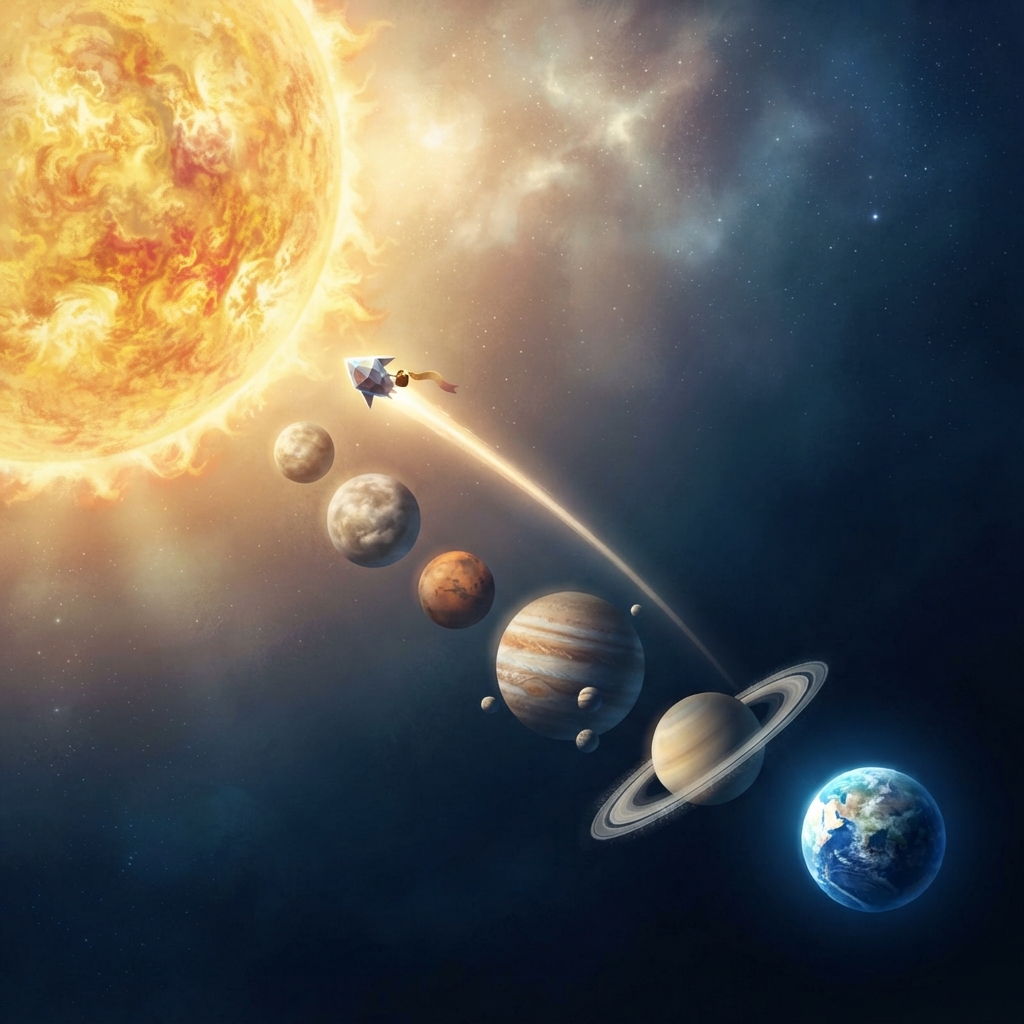
Postcards from a Sunbeam
For every child who looks up and feels the map get bigger.
What's inside
Where the Sunbeam Begins The Blue Card and the Red One Giants in the Cold The Far Postcards
The Star That Holds Everything
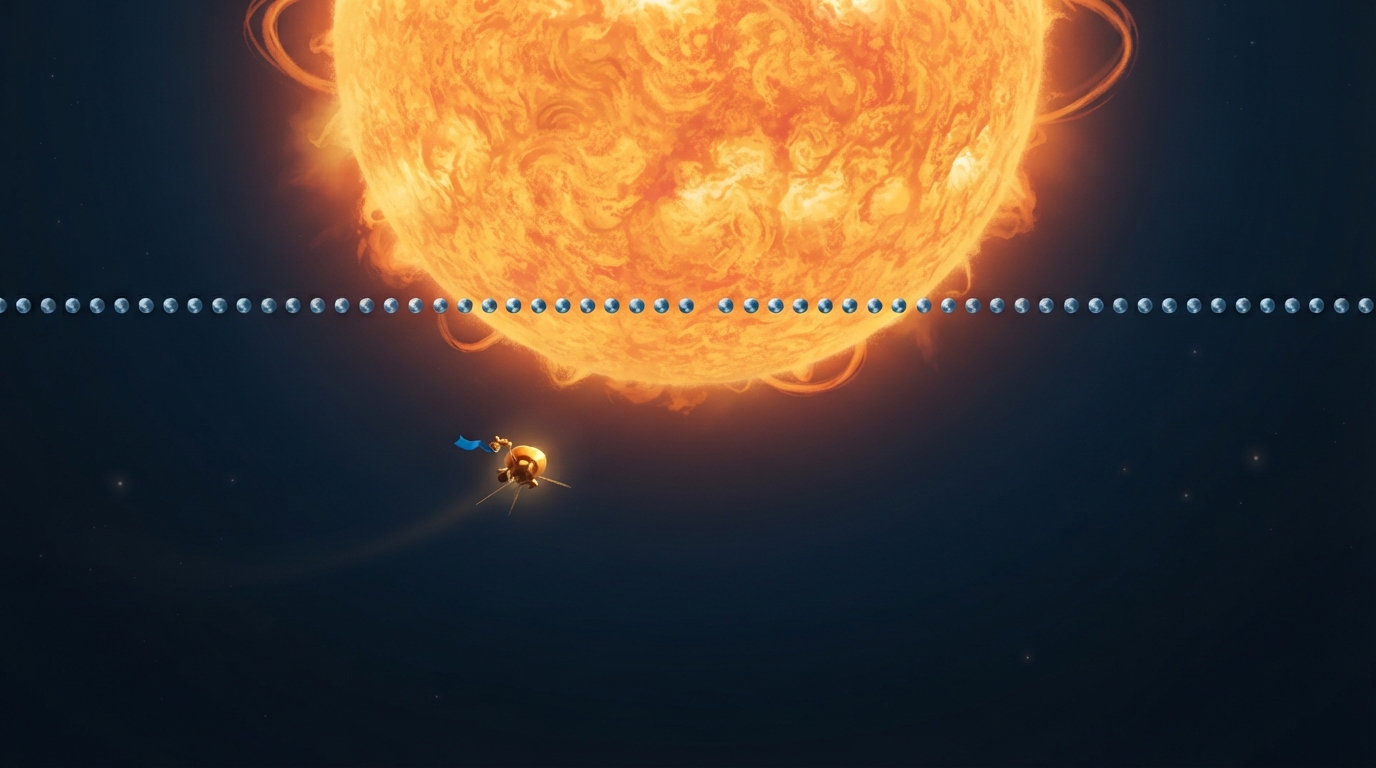
Welcome to the address where every postcard begins: the Sun. It is not a campfire in space. It is a huge star, an ocean of glowing plasma—gas so hot its tiny particles carry electric charge. Its powerful gravity is like an invisible tug that keeps planets circling instead of flying away. From our tiny light-beam ship, you can begin to feel the Solar System’s astonishing size.
Light Is Our Ruler
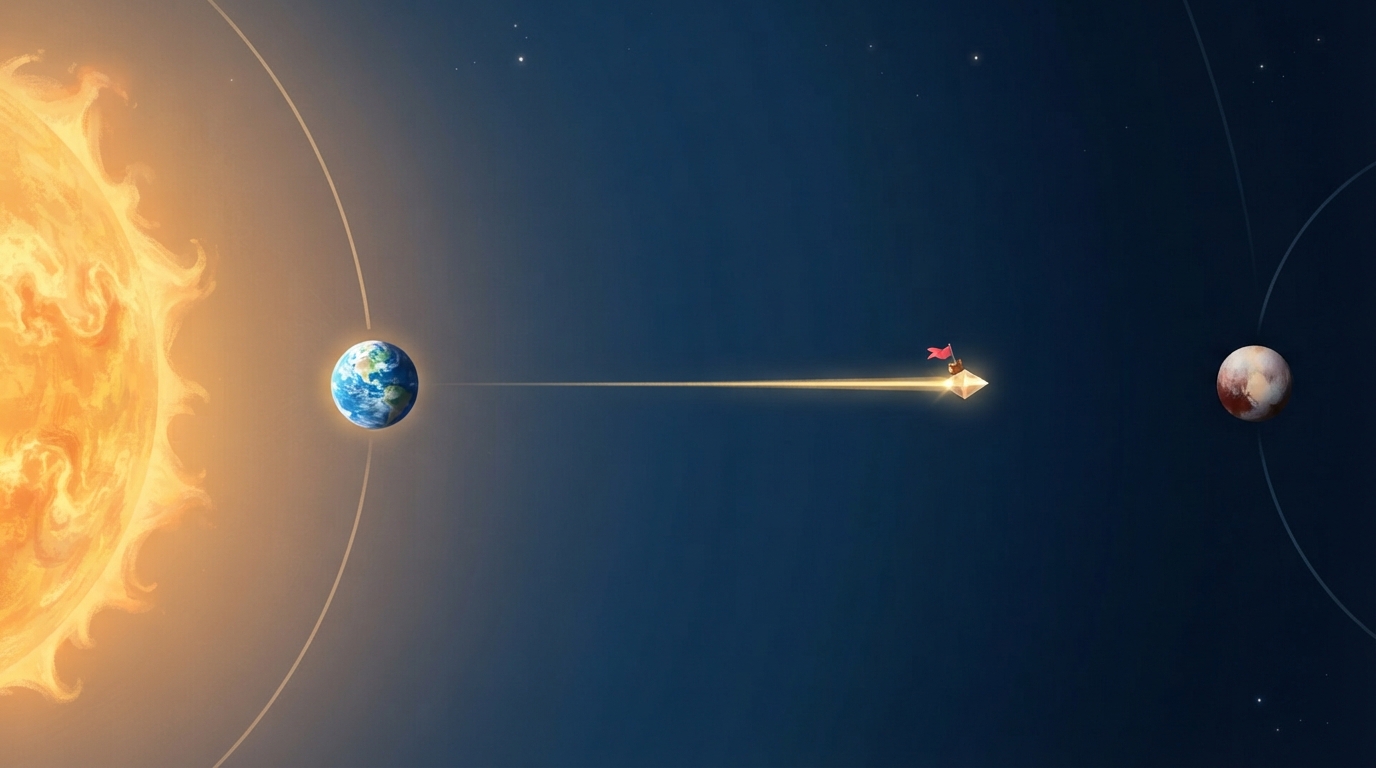
How can you measure a neighborhood when the houses are worlds apart? Use light. Light moves incredibly fast, but space is so wide that it still needs time to cross it. A ray leaving the Sun reaches Earth in about 8 minutes. Keep following that same ray outward, past the far planets, and it reaches Pluto in about 5.5 hours. That travel time is called light-time. It turns an invisible distance into something you can imagine: while sunlight is arriving at Earth, it is still hours away from Pluto. The long, quiet gap is the lesson—the Solar System is mostly space.
Two Years for One Day
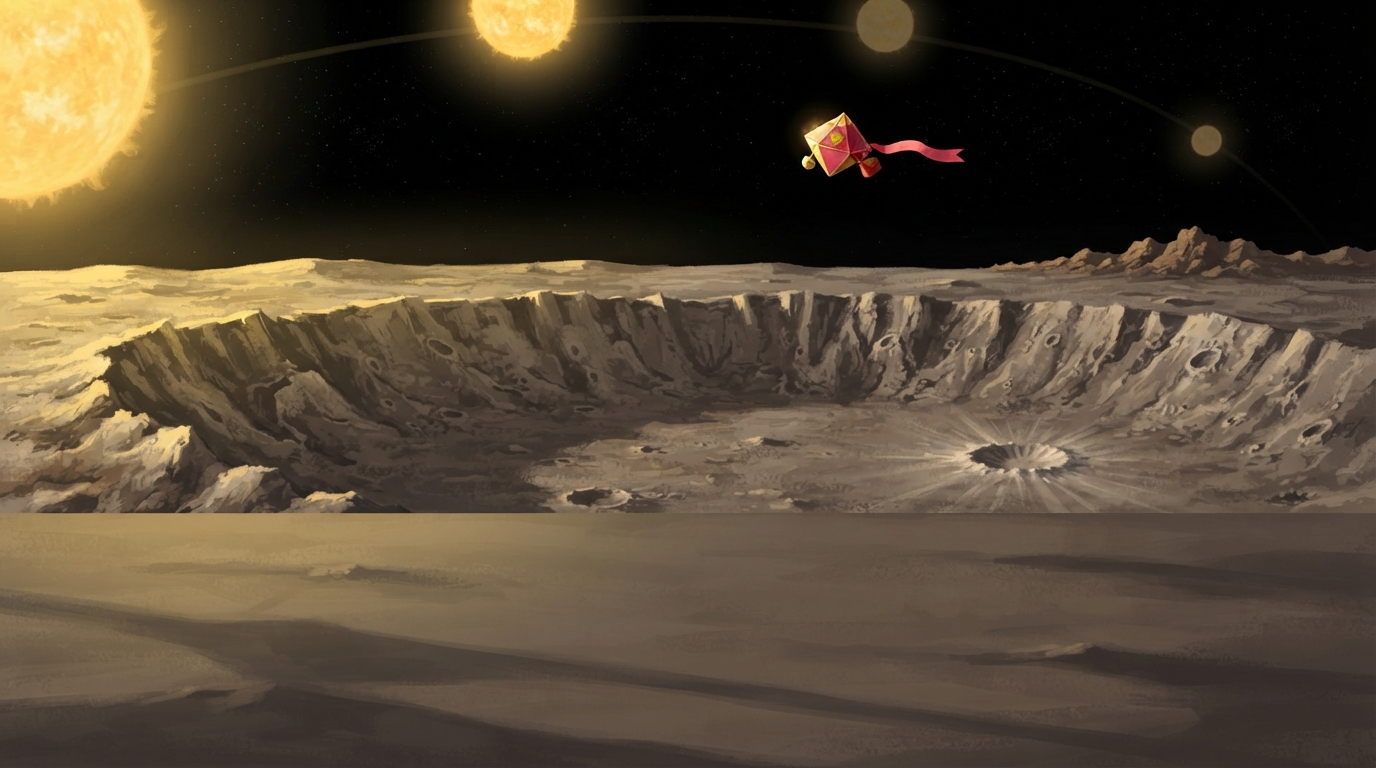
Mercury is the Sun’s nearest planet: a small rocky world with a surface pocked by craters, bowl-shaped dents made when objects crash into it. You might expect the nearest planet to have the quickest day. Here comes the surprise. Mercury races once around the Sun in 88 Earth days, yet one sunrise-to-sunrise day lasts 176 Earth days. That is a little more than two Mercury years! Its spin and its orbit work together in an unusual rhythm, so the Sun seems to crawl across Mercury’s black sky. Close to the Sun does not always mean simple.
Venus Wears a Hot Blanket
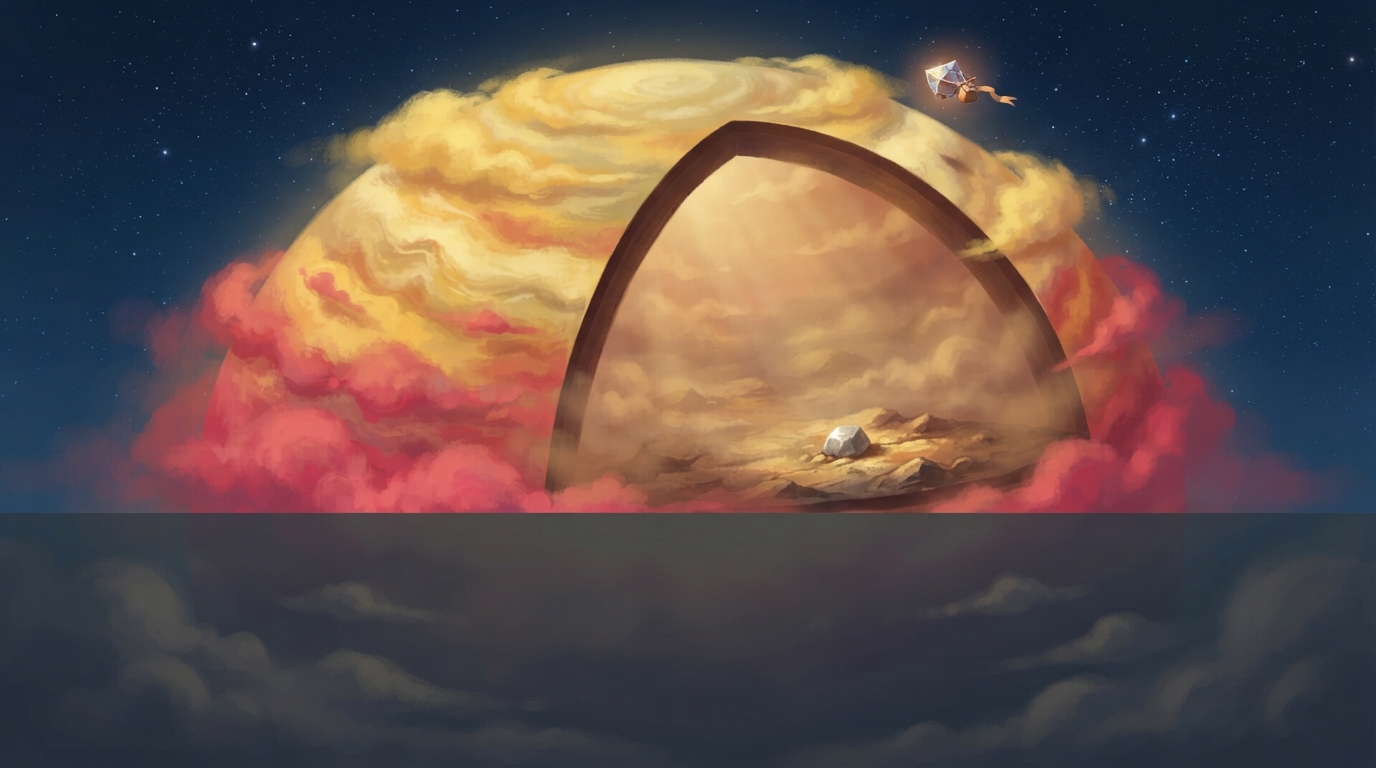
Venus is farther from the Sun than Mercury. So which world is hotter? Many people guess Mercury, but Venus wins by far. Venus wears an atmosphere, a blanket of gases, so thick that heat has trouble escaping to space. Sunlight warms the ground; then the dense air traps much of that warmth. This is the greenhouse effect, like a blanket holding in your body heat—only vastly stronger. Venus’s surface is about 872°F, or 467°C, hot enough to melt lead. Mercury has almost no atmosphere to hold heat in. Distance matters, but a planet’s air can matter even more.
Earth Can Write Back
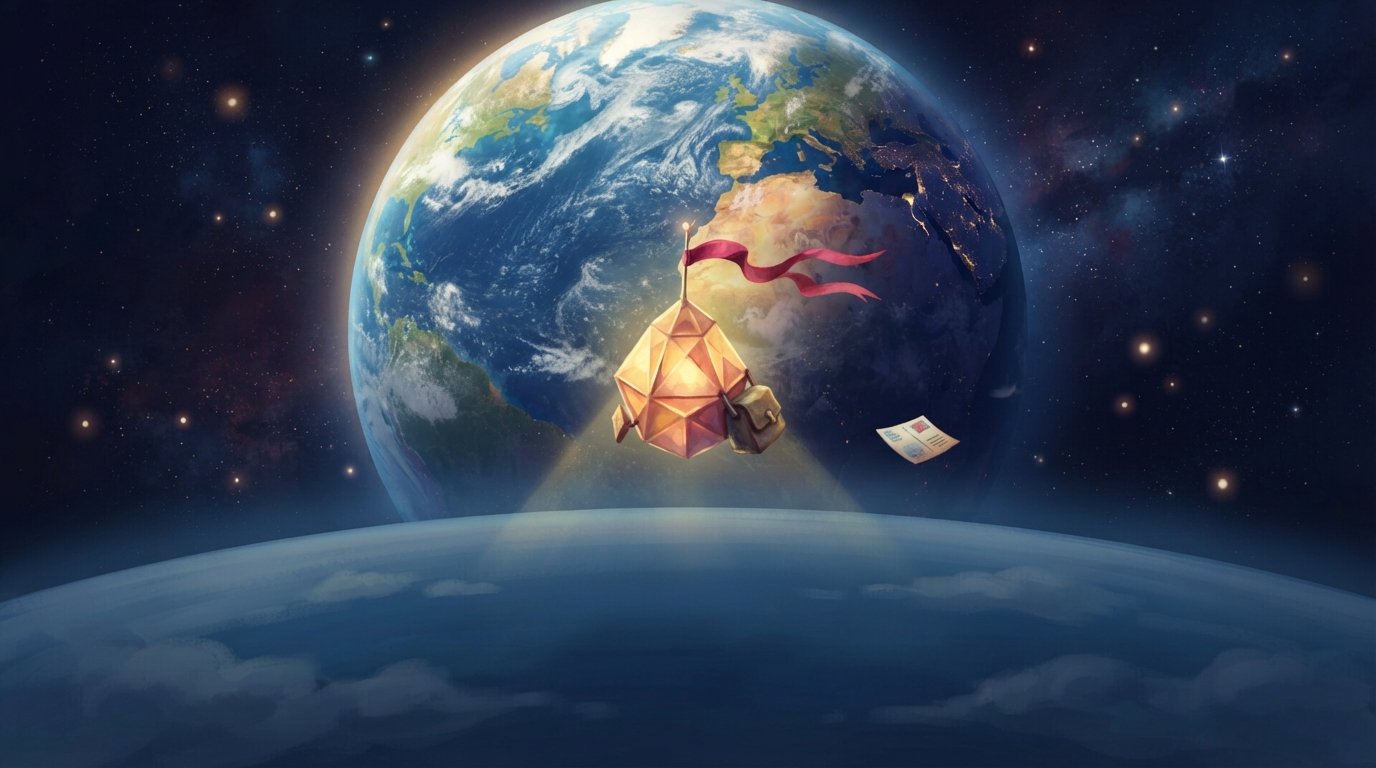
Here is our blue-ocean postcard: Earth. White clouds curl above seas, rocky land, and living things. It is the only world we know that supports life. From this small home, people can look outward, explore with spacecraft, and send their own postcards into space.
The Moon Keeps Footprints
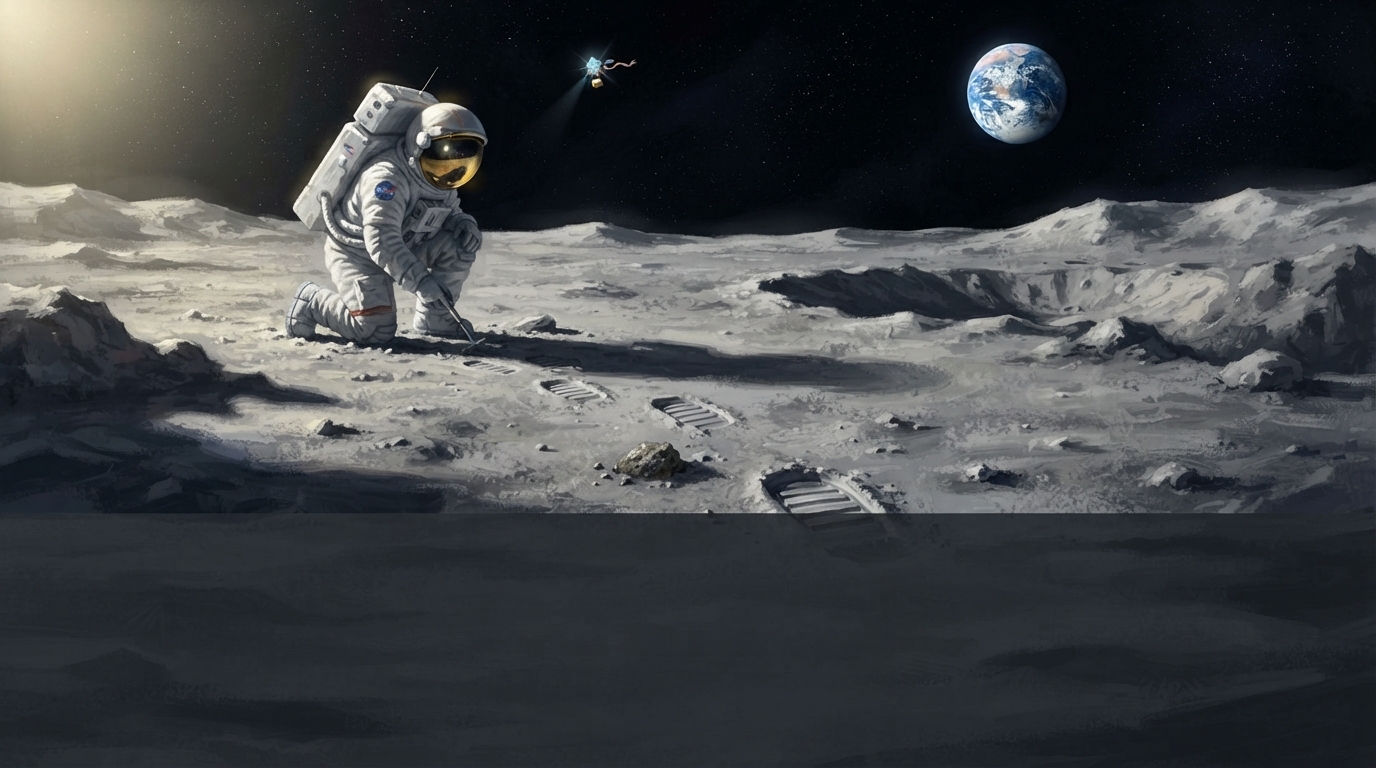
Try to picture a footprint in wet sand. Wind, rain, and waves can soon blur it away. The Moon has no air blanket called an atmosphere, so it has no wind or rain. Its dusty ground can keep astronaut bootprints for millions of years. Tiny space rocks still strike the Moon, making bowl-shaped dents called craters. Yet changes happen very slowly compared with changes on Earth. Those sharp prints are quiet clues from visits long ago.
Mars Builds a Giant
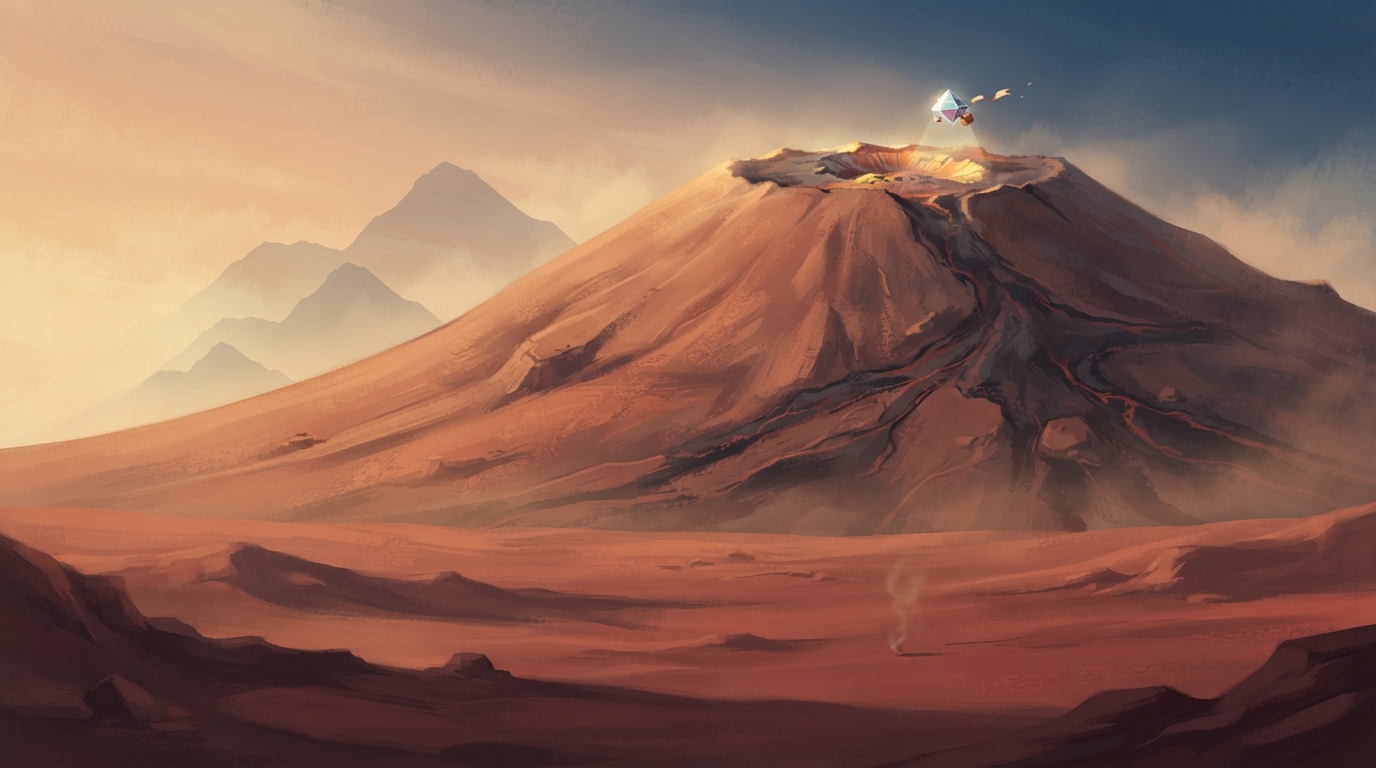
Mars looks rusty red because its dust contains iron, the same kind of metal that can rust on Earth. But its biggest volcano is even more startling. Olympus Mons rises about 16 miles, or 25 kilometers, high. That is nearly three Mount Everests stacked upward! A volcano is a place where melted rock and gases can rise from inside a world. Olympus Mons is broad as well as tall, like a huge, gently sloping mountain spread across Mars. Mars has a very thin atmosphere, so you could not hike there without a spacecraft suit.
Not a Rock Chase
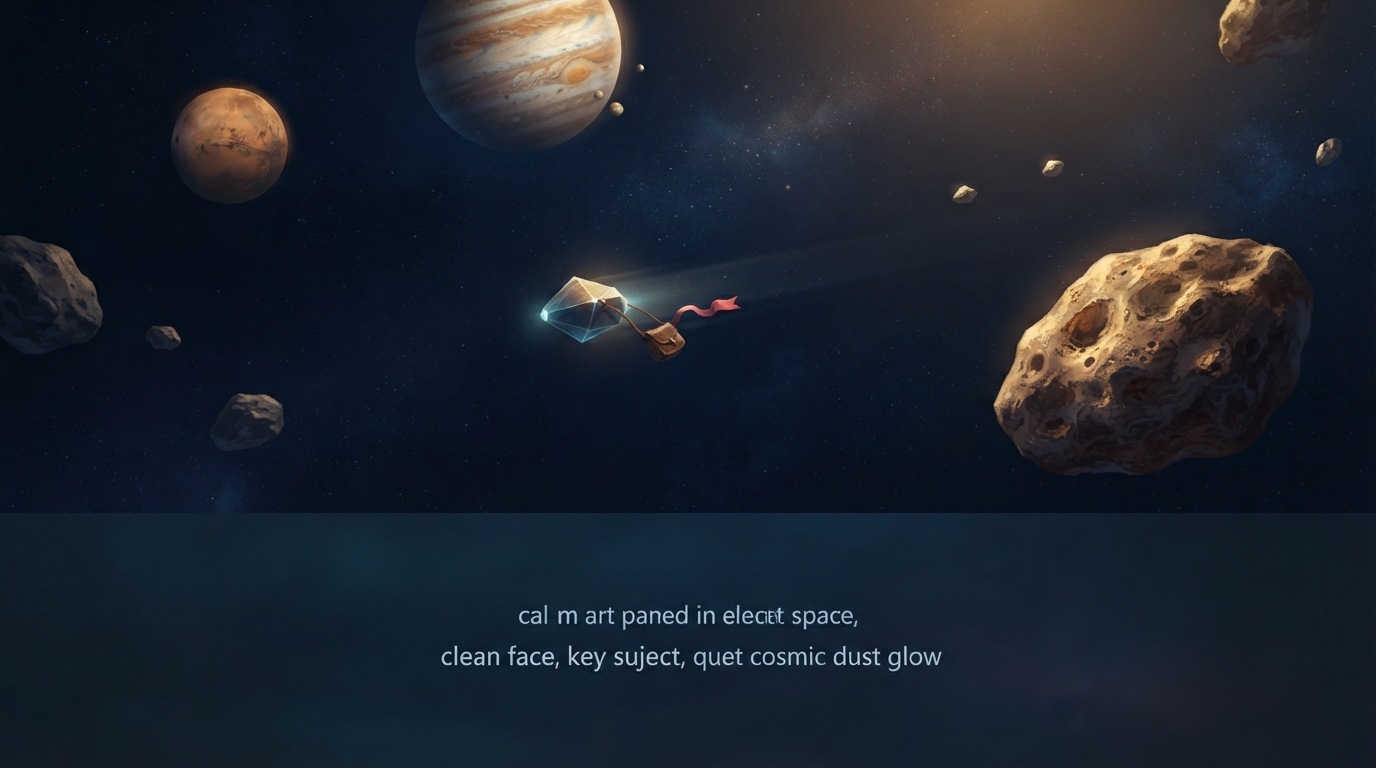
Movies sometimes show the asteroid belt as a wild traffic jam. Actually, it is mostly empty space. Asteroids are small rocky objects that orbit the Sun, and they are spread across a huge region between Mars and Jupiter. These rocks are leftovers from the Solar System's beginning. They never gathered into a planet. Jupiter's powerful gravity helped keep that from happening. A spacecraft can travel through the belt without zigzagging between boulders. Our light-beam ship could point straight toward the next postcard, with only a few faraway rocks glinting in the dark.
Where Planets Grow Huge
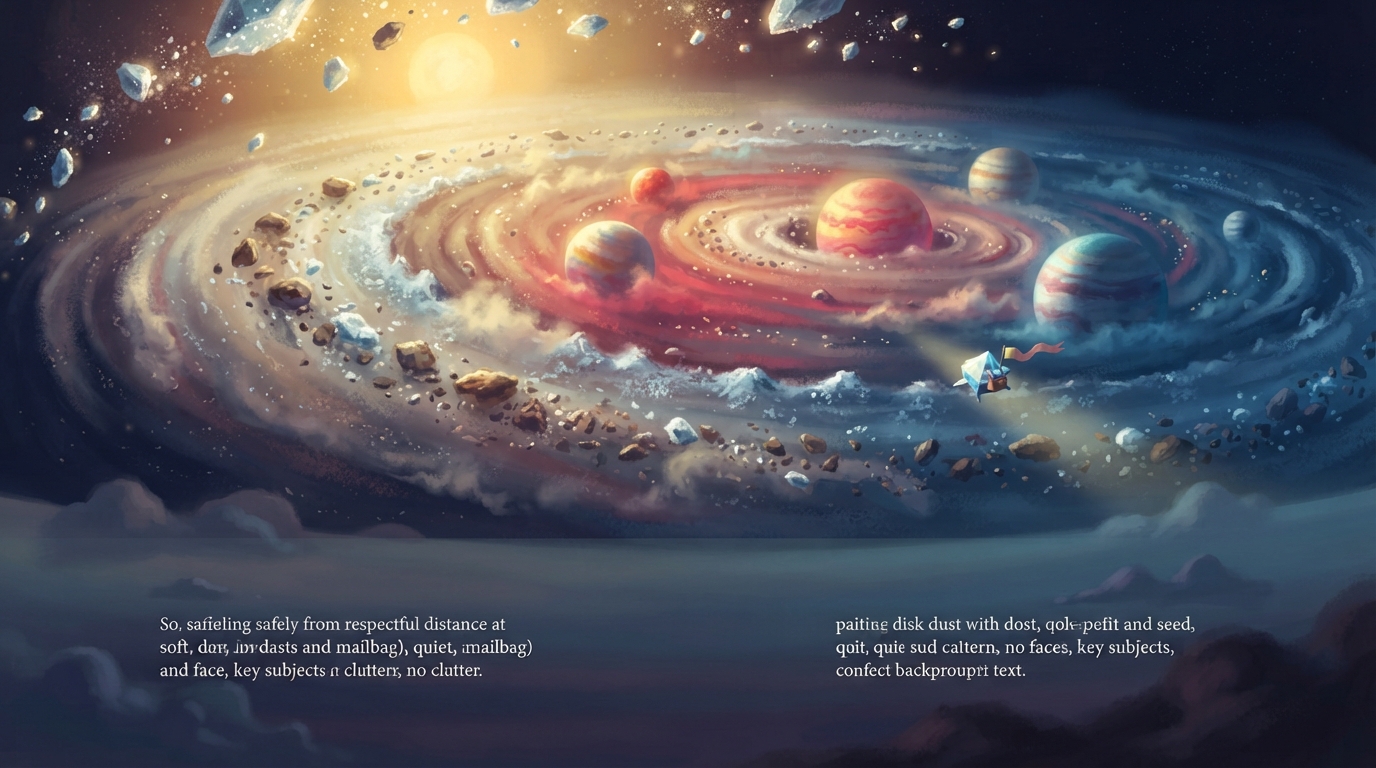
Beyond the asteroid belt, the young Solar System was cold enough for ice to stay solid. That meant more building material: ice, rock, and gas. Gravity gathered it all, and the planets here grew enormous. Our tiny light-beam ship sends a postcard home from the chilly giant-world country.
Jupiter’s Giant Red Storm
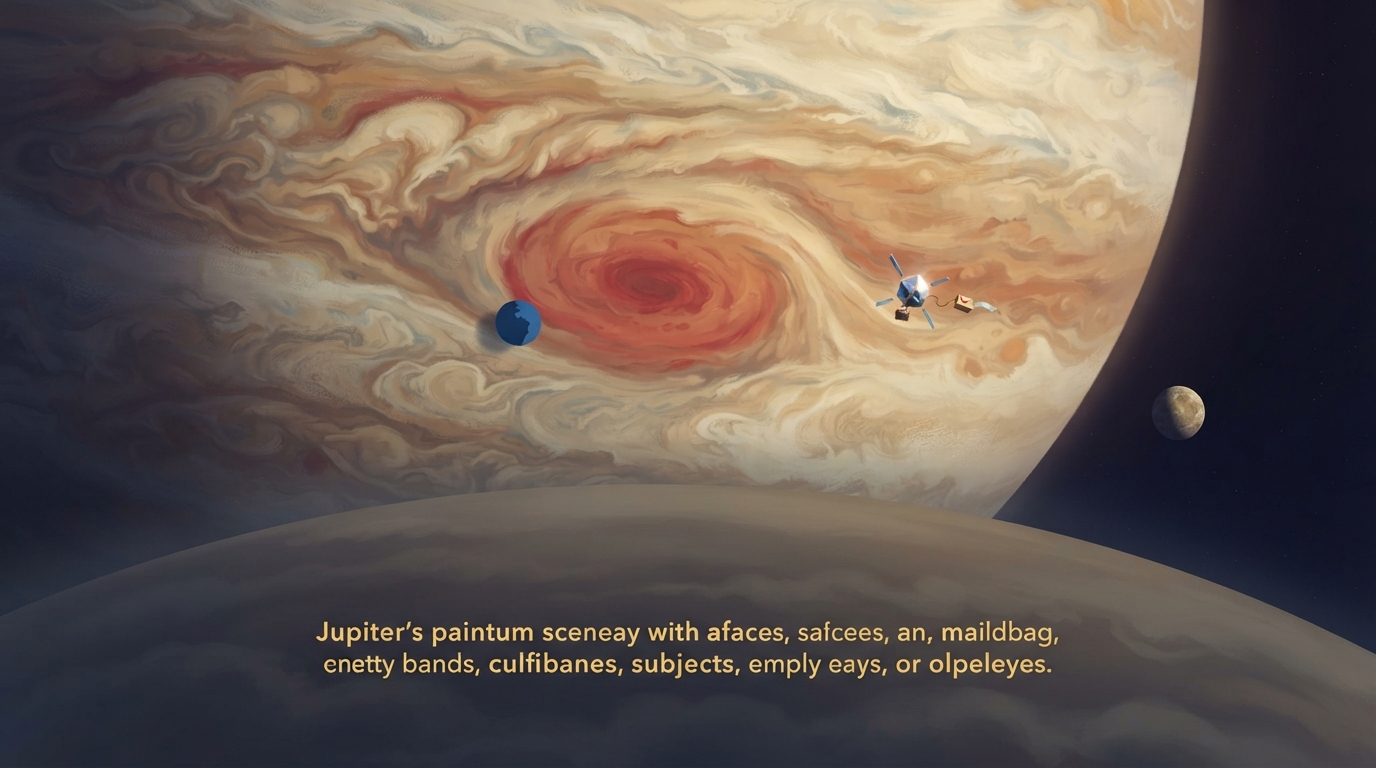
Jupiter is the Solar System’s largest planet. If it were a hollow ball, about 1,000 Earths could fit inside. Its striped clouds are layers of atmosphere rushing in different directions. Then there is the Great Red Spot: a huge spinning storm, wider than Earth, that has lasted for hundreds of years. Think of a hurricane, but stretched across a world so large that our whole planet could fit inside its width. Jupiter has no solid surface to land on; its deep atmosphere becomes denser and denser below the clouds.
Saturn’s Almost-Invisible Rings
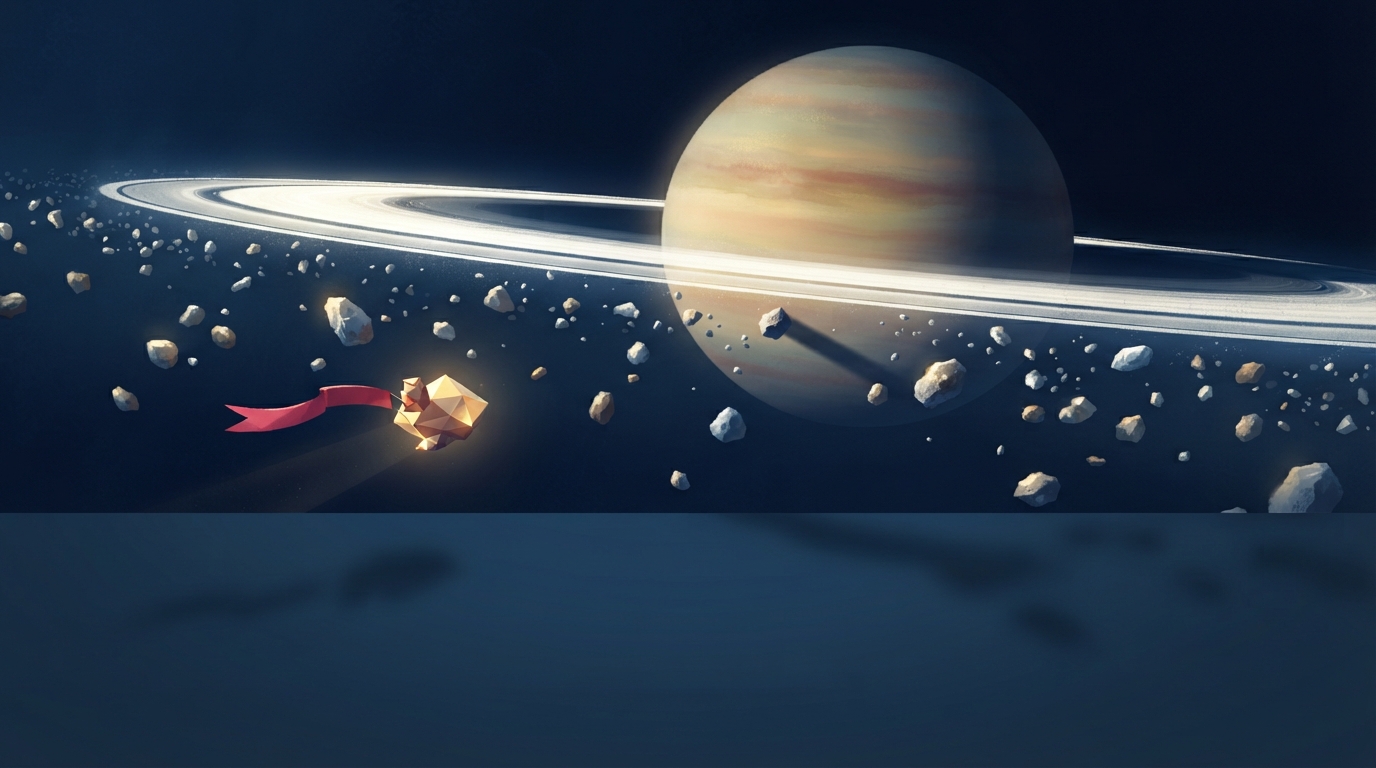
From far away, Saturn’s rings look like bright, solid hoops. But they are not roads or sheets. They are countless separate pieces of water ice, each orbiting Saturn like a tiny moon. The rings reach about 175,000 miles, or 282,000 kilometers, from Saturn. Yet in many places, they are only about 30 feet, or 10 meters, thick—thinner than a house is tall. How can something be so wide and so thin? Picture a giant, glittering skating rink seen exactly from its edge: it nearly disappears into a line. Saturn’s gravity keeps the icy pieces circling instead of drifting away.
Uranus Rolls Sideways
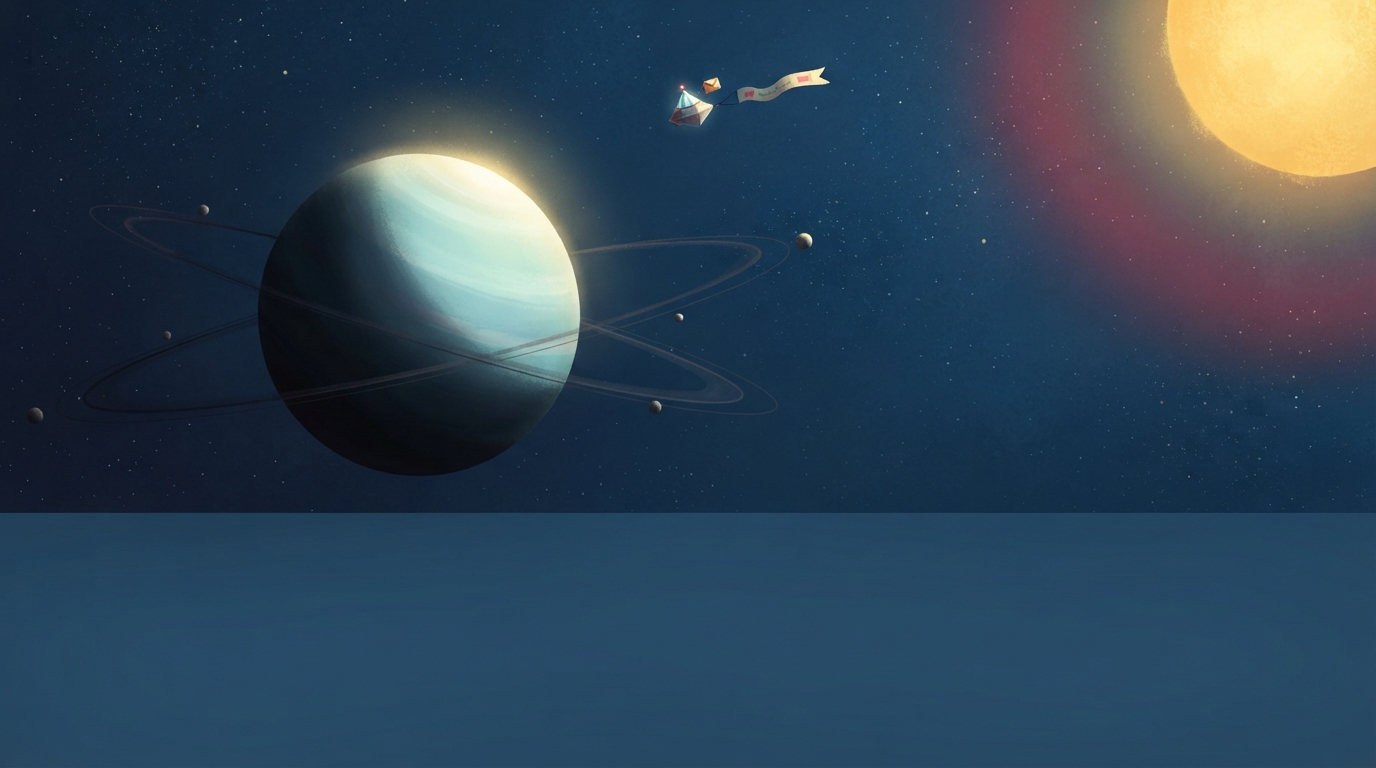
Most planets spin like tops with a small lean. Uranus is different: its spin axis, the invisible line through its poles, is tilted about 98 degrees. It is almost lying on its side as it travels around the Sun. Imagine rolling a ball around a lamp while the ball’s north end points at the lamp. For part of Uranus’s long trip, one pole faces the Sun while the other stays in darkness. That can bring polar winters lasting 21 years. Its blue-green color comes from gases in its atmosphere that absorb some colors of sunlight. Far from the Sun, Uranus is a cold, quiet-looking world with a very surprising tilt.
Neptune’s Racing Blue Clouds
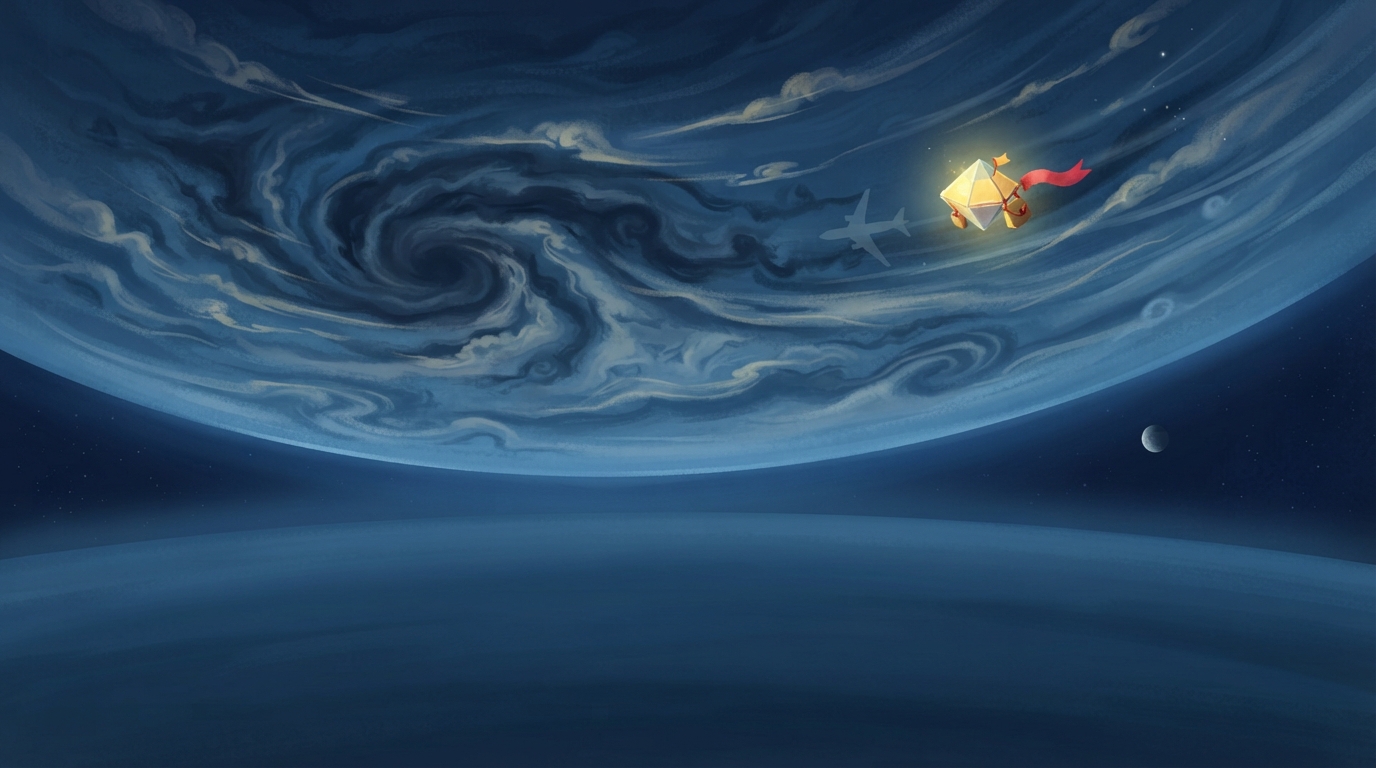
At the eighth planet, sunlight is faint—but Neptune’s weather is anything but quiet. From our tiny ship, you will skim above a blue cloud world where winds race faster than a jet. Then the last postcards travel farther, toward icy Pluto, a belt of small worlds, and a spacecraft carrying hello from Earth.
Pluto Still Gets a Stamp
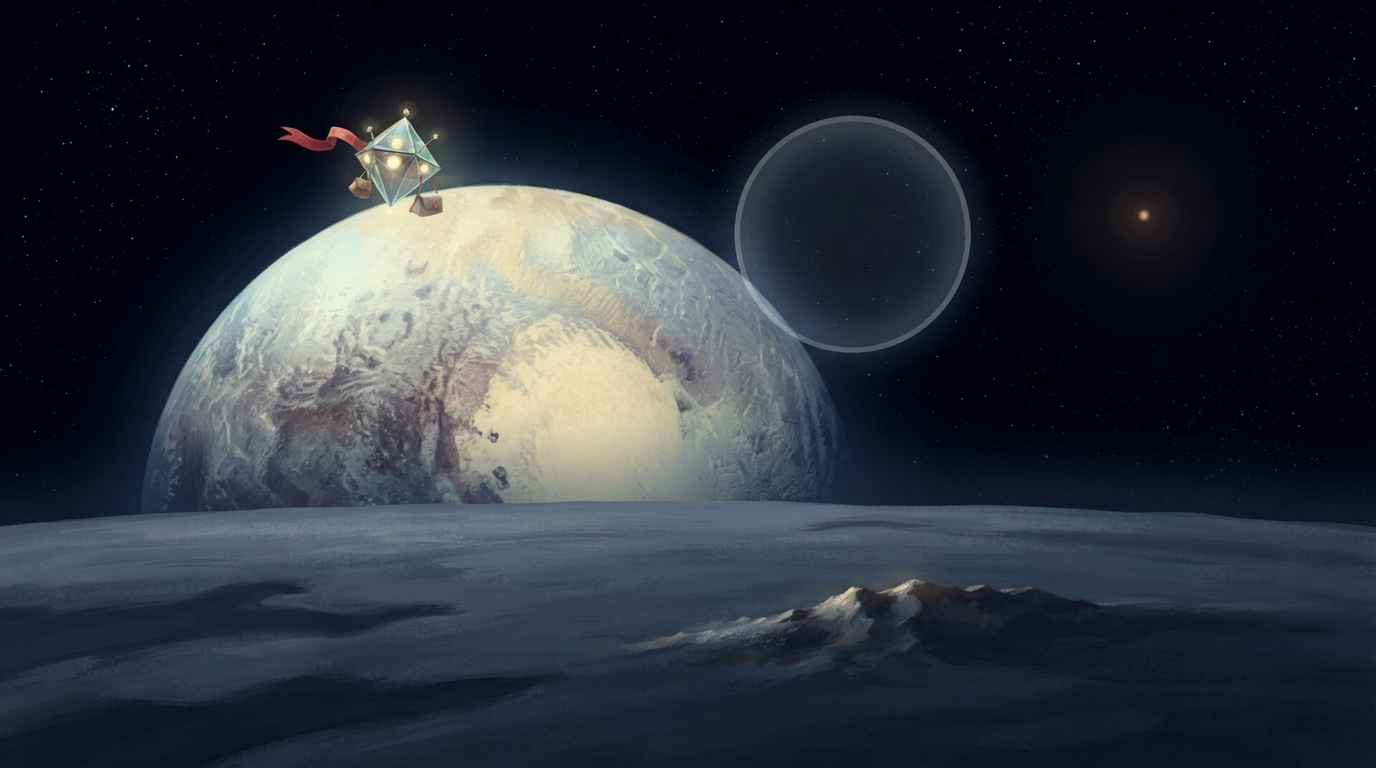
Pluto is a dwarf planet: a round world that orbits the Sun but has not cleared away other objects nearby. That title does not make Pluto less interesting. It is only about one-fifth as wide as Earth, yet it has mountains, icy plains, and a bright region shaped like a heart. From this far out, a sunbeam needs about 5.5 hours to reach Pluto. At noon, the Sun would look small and dim—but not gone. The Solar System does not end neatly at Neptune. Beyond it lies the Kuiper Belt, a faraway zone of icy leftovers, including Pluto and many other small worlds.
Voyager’s Golden Hello
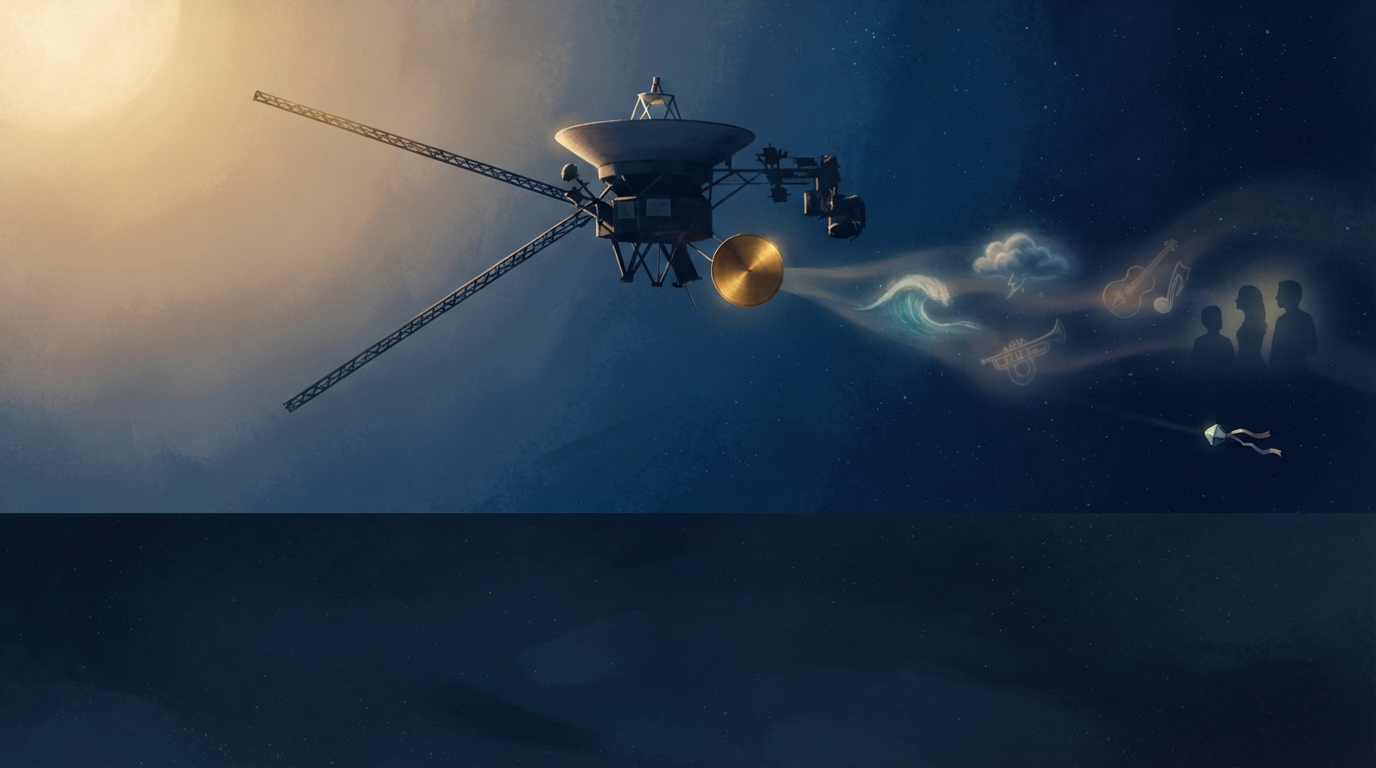
Far beyond the planets travels Voyager 1, the farthest human-made object. It is a robotic spacecraft, built by people to explore places no person could visit. Voyager carries a Golden Record, a golden disk like an old music record. It holds greetings in 55 languages, along with music, pictures, and sounds from Earth—waves, thunder, and more. It is a time-capsule postcard from our whole planet. Voyager has reached interstellar space, the space between stars, beyond the Sun’s protective bubble. Its journey is quiet and cold, but its record says something wonderfully warm: Earth was here, and Earth wanted to say hello.
Mail a Postcard to the Sky

Make a sky postcard, then visit the real night sky with a grown-up.
Check your wonder
New words
Where we looked
This book was researched using web sources from NASA and other well-established space-science knowledge.
The end
You have traveled from the Sun’s glowing plasma to icy worlds beyond Neptune, learning how gravity, light, air, heat, and impacts shape each place. You also know that Earth’s blue-ocean postcard is wonderfully special—and that Voyager carries a tiny hello from home into the dark. Keep looking up and wondering what other stories our sky is waiting to share.